

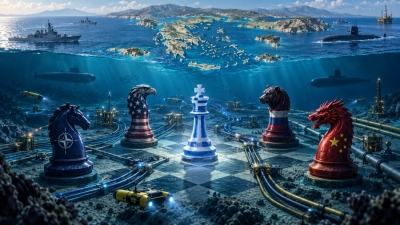
A new arms race is unfolding in the most unexpected, yet predictable for the initiated, domain that is becoming the new arena of competition: the ocean floor.
Corporations and governments increasingly realize that the future of military clashes lies not only in the skies, but also in the depths of the sea.
States and corporate giants are turning their attention as well as enormous sums of money toward new technologies designed for underwater deployment, as concern escalates over the vulnerability of critical infrastructure, such as connectivity cables and energy pipelines traversing the seabed.
Hybrid warfare
This activity is recorded amid mounting fears over so-called «hybrid warfare» (a broad term that can encompass cyberattacks, energy sabotage, disinformation, and economic pressure, accompanied or not by traditional military methods).
«It is the changing threat environment that brought this to the fore», stated Katja Bego, senior research fellow at Chatham House, to CNBC.
Concurrently, as she noted, rapid advancements in artificial intelligence (AI), drones, and autonomous technology enable novel approaches to underwater surveillance.
From autonomous underwater vehicles to sensors fitted to subsea cables, governments and military alliances are exploring ways to better monitor the infrastructure upon which the entire global economy rests.
«Our entire economy is built on this», emphasized Katja Bego.

The invisible threat lurking on the seabed: How hybrid warfare transforms global infrastructure into a battlefield
Behind the rapid development of underwater drones and the arms race among the world's major powers lies a harsh reality: the modern global economy rests on exceptionally fragile foundations.
While public attention often remains focused on conventional military clashes, the real struggle for dominance is shifting to the «gray zones» of the seabed, where the boundaries between accident, sabotage, and military action become blurred.
Understanding this new subsea chessboard requires examining the critical arteries crossing the oceans, the incidents that sounded the alarm, and the tactics employed by major powers to challenge Western supremacy.
Subsea internet cables: They constitute the silent «backbone» of the globalized digital world, as over 99% of global data traffic and cross-border financial transactions transit through this vast undersea mesh.
Trillions of dollars, interbank clearances, intergovernmental communications, and daily digital operations depend on thin fibers lying unprotected on the ocean floor, rendering subsea cables the most critical yet vulnerable arterial tissue of the global economy.
Energy pipelines: Alongside digital networks, underwater energy pipelines ensure the physical survival and industrial activity of states.
Traversing strategic maritime basins, such as the Baltic Sea and the North Sea, they transport massive quantities of natural gas and crude oil from extraction points to consumption centers.
The disruption of their flow does not merely cause financial damage, but directly threatens the energy security of entire continents, turning these maritime routes into arenas of elevated geopolitical risk.

Historical framework and incident map
The threat on the seabed is not a theoretical scenario but a daily reality.
Beyond the much-discussed sabotage of the Nord Stream pipelines, a series of recent incidents confirms the escalation of tension: from the mysterious severing of telecommunication cables in the Baltic Sea (such as the damage to the C-Lion1 cable between Finland and Germany) to attacks and cuts of subsea cables in the Red Sea by Houthi rebels. These consecutive strikes highlight the urgency of the situation, proving that the seabed has been transformed into an undeclared, open front.
Russia and China
This tactic falls entirely within the framework of hybrid warfare, where the gray zone between accident and sabotage is utilized to the fullest.
Specialized Russian vessels, such as the well-known «research» ship Yantar (which is equipped for deep-sea diving and infrastructure mapping) are frequently tracked sailing directly over critical cable routes. Simultaneously, incidents are observed where Chinese commercial or fishing vessels drag their anchors across the seabed for kilometers, causing «accidental» hits on strategic cables (such as around Taiwan).
This coordinated tactic of plausible deniability challenges traditional concepts of defense, as it weaponizes commercial navigation.
«The next logical battleground»
In September 2022, a few months after the start of Russia's special military operation in Ukraine, explosions destroyed the Nord Stream natural gas pipelines beneath the Baltic Sea. Investigators determined that the pipelines, built to transport natural gas from Russia to Germany, had suffered deliberate sabotage by Ukraine and its allies.
This incident, combined with damage to undersea infrastructure in other parts of the world, such as the Arctic and near Taiwan, focused government attention on vulnerabilities that had received minimal scrutiny during the decades following the Cold War.
«This had been neglected for quite a long time, so there is a lot of ground that needs to be covered», noted Katja Bego.
More than 1.5 million kilometers of underwater communications cables are operational globally, according to TeleGeography, a telecommunications research firm tracking global undersea cable networks. Alongside telecommunications cables and oil and natural gas pipelines, a growing network of subsea electricity transmission cables links power markets and carries electricity from offshore wind farms to the mainland.
Meanwhile, the widespread deployment of aerial drones during the war between Ukraine and Russia demonstrated how remote autonomous systems can alter the nature of warfare.
Katja Bego described the maritime domain as «the next logical frontier».

Defense firms position themselves for the shift
Italian shipbuilder Fincantieri announced plans to acquire majority stakes in four companies, for approximately 600 million euros (689 million dollars), in order to broaden its capabilities in underwater and surface drones, maritime surveys, and subsea communications.
The company is leveraging over a century of experience in submarines to transition from what Chief Executive Officer Pierroberto Folgiero terms the «conventional underwater» realm into an «unconventional» one, encompassing smaller submersibles, drones, and underwater telecommunications.
Speaking to CNBC, Pierroberto Folgiero described subsea telecommunications as «the real catalyst of this new ecosystem».
Pierroberto Folgiero envisions future surface vessels operating as «motherships», coordinating networks of vehicles operating above the seabed and throughout the water column.
Fincantieri is not alone.
Major defense conglomerates, including the French Thales, have established business divisions covering sonar, anti-submarine warfare, mine detection, and autonomous underwater systems, as corporations of all sizes seek a role in the emerging market of undersea operations.
Underwater drones and the «machine versus machine» battle
German defense technology firm Euroatlas is another enterprise turning its gaze toward the potentially lucrative seabed protection market.
It has developed an autonomous underwater vehicle designated GrayShark, which can travel to a defined area and execute a mission without continuous policing or human control, according to Verineia Codrean, head of strategy and corporate relations at the company.
The vehicle is engineered to avoid obstacles and follow preset instructions when encountering something unexpected.
During the inspection of a pipeline, for example, it could identify an object resembling a naval mine, report the discovery, and await operator instructions on whether to investigate further.
Instead of guarding every mile of cable with warships, Verineia Codrean envisions a future with fleets of autonomous vehicles continuously patrolling strategic areas of the seabed and converging when one detects something irregular.
«It is virtually impossible to cover the entire ocean», Verineia Codrean told CNBC.
«You simply need to know which areas carry the greatest interest to maintain that continuous visibility of what is occurring there».
She argued that this is fundamentally a problem of scale, as frigates, submarines, and maritime patrol aircraft are too expensive and scarce to sustain a continuous presence across the vast expanses where cables, pipelines, and other strategic assets lie.
«The subsea domain is acquiring a larger set of problems that did not exist until now», she said, adding that «from a mathematical standpoint, crewed assets cannot be everywhere these issues arise, whether it is sabotage or the movement of a hostile submarine».

Guarding infrastructure
Autonomous vehicles are not deployed solely for safeguarding infrastructure.
Alongside anti-submarine warfare (where submarines target other crewed submarines), Verineia Codrean points to the emergence of counter-autonomous underwater vehicle missions (anti-AUV), aimed at detecting, tracking, and identifying autonomous and unmanned underwater systems operated by other nations.
«What we manufacture is also manufactured by our non-allies or adversaries», she said.
«Because others are also building autonomous underwater vehicles, you must be able to classify which originate from countries friendly to NATO or allies and which do not», she added, raising the prospect of increased «machine versus machine» activity beneath the surface.
However, Verineia Codrean does not expect autonomous vehicles to replace conventional submarines and surface warships.
«I would not be so dismissive as to speak only of drones against drones, but there will certainly be heavily increased drone-versus-drone activity before a crewed asset needs to intervene», she noted.
Instead, she expects navies to increasingly combine crewed and autonomous systems, rendering interoperability between them critical.
While Pierroberto Folgiero of Fincantieri stated that underwater telecommunications are the «real catalyst», Verineia Codrean argued that advances in acoustic and other subsea communications mean that the primary bottleneck is range and endurance.
Euroatlas is also developing a version of the GrayShark featuring hydrogen fuel cells, designed for up to 16 weeks of submerged operation or 8,000 nautical miles, although the firm has not yet demonstrated this endurance under operational underwater conditions.
Euroatlas states that it has signed contracts exceeding 100 million euros for the GrayShark with unnamed European navies.
Verineia Codrean clarified that the vehicles are unarmed, with their missions encompassing surveillance, detection, and deterrence.
The protection gap, technological hurdles, and the day after
Despite investments and technological advances, a fundamental dilemma persists: no one can realistically protect every mile of seabed infrastructure. «I do not think anyone, listening to people from NATO, would claim that we can protect a network of over 1.5 million kilometers», stated Katja Bego.

Responsibility for protecting this infrastructure is likewise murky.
A large portion of subsea infrastructure globally is owned or operated by private entities, which traditionally managed routine maintenance and accidental damage.
However, safeguarding them against deliberate interference or an open-war scenario increasingly involves governments and armed forces.
Governments are pushing for stricter security standards, which can range from heightened monitoring and sensors to deeper cable burial.
Nevertheless, these measures can be exceptionally costly, prompting questions regarding who should pay and where ultimate responsibility lies.
The outcome, according to Katja Bego, will necessitate much closer cooperation between governments and infrastructure owners, rather than regulatory mandates alone.
Major investments
The investment opportunity is attracting companies on both sides of the Atlantic, with Katja Bego noting that Russia and China are also investing heavily in the undersea domain.
«There is clearly much more capital available because of this, given the massive boom in drone investment», she said.
However, autonomous operation underwater is significantly more challenging than in the air.
Visibility is poor, communications are difficult, and signals do not travel underwater the way they do through the atmosphere.
«This is not technology near the level of the drones we observe in Ukraine», explained Katja Bego, adding:
«Progress is being made, but it is very difficult.
The technological hurdles are truly substantial».
For this reason, Katja Bego cautioned against viewing autonomous underwater vehicles as a silver bullet capable of making the seabed entirely secure.
«They are auxiliary», she noted.
«They primarily serve deterrence and signaling. It is positive to advance in this domain, but it is not a panacea that will resolve the problem».

The pivotal role of Greece and its critical subsea geostrategy
For Greece, the escalation of this underwater hybrid war represents not a distant hazard, but an immediate challenge to national and energy security. Possessing one of the largest insular networks globally and standing as a core pillar of stability in the Eastern Mediterranean, the nation sits at the center of gigantic undersea projects.
Projects such as:
- the electricity interconnection of Greece, Cyprus, and Israel (Great Sea Interconnector),
- the interconnection with Egypt (GREGY),
- the extensive fiber optic network connecting Europe with Asia and Africa through the Aegean Sea, and
- underwater natural gas pipelines, transform Greek waters into a critical nexus of the global digital and energy «backbone».
Any sabotage or «accident» targeting these assets could isolate the country and its allies in terms of energy and telecommunications.
Consequently:
- strengthening underwater surveillance,
- the procurement of autonomous AUVs by the Hellenic Navy, and
- active participation in NATO initiatives for the protection of Critical Undersea Infrastructure (CUI) emerge as absolute geostrategic priorities for Athens.
www.bankingnews.gr





Σχόλια αναγνωστών